Peninsula ADUs · Attached · Detached · Garage Conversions

ADUs, built for real life and real returns.

California's 2026 law updates just widened what you can build. We help Peninsula homeowners and investors turn that opening into a detached home office, a guest house, a rental income stream, or a place for family, all while keeping the permit process and the build on schedule.

Who We Build ADUs For

Two different reasons. One standard of work.

About half of the ADUs we build are for homeowners adding space to their own property. The other half are for investor partners scaling rental income or building value into properties they plan to sell. The legal requirements are the same. The build details, cost sensitivity, and finish specs are not.

For Homeowners

More space. Same address.

An ADU is usually the right answer when you love where you live but the house no longer fits your life. Common reasons our clients build one:

  • Multi-generational living. Aging parents who want independence, or adult kids moving back home.
  • Private home office or studio. Separate from the house, with its own entry and HVAC.
  • Rental income. Offset the mortgage, or turn a paid-off property into a monthly yield.
  • Guest house. A real place for visiting family, rather than a converted spare room.
  • Future flexibility. Build it now, use it for one thing today, repurpose it later.

We design around how you'll actually use the space, not around a generic ADU template. A primary-suite ADU for an aging parent is a different building than an income rental, even if the permit looks identical.

For Investors & Developers

Yield per square foot, built to spec.

We work with investment groups and individual investors building ADUs as rental-income plays, flip enhancements, or long-term rental additions. On the investor side, a few things matter more than they do for homeowner builds:

  • Cost per square foot discipline. We scope tight and value-engineer without sacrificing rental quality.
  • Permit velocity. California's 60-day review cap is a tool when you know how to submit complete plans the first time.
  • Hybrid on-site + off-site construction. Where off-site fabrication makes sense, it often cuts weeks off an investor timeline.
  • Repeatable specs. For portfolio plays, we work from a tuned spec sheet that stays consistent across properties.
  • Clean accounting. Line-item invoicing, clean lien waivers, documentation your lender or partner needs.

If you're running a portfolio or a flip, we can talk through the numbers before you commit, not after.

What We Build

Four kinds of ADU, depending on the lot and the goal.

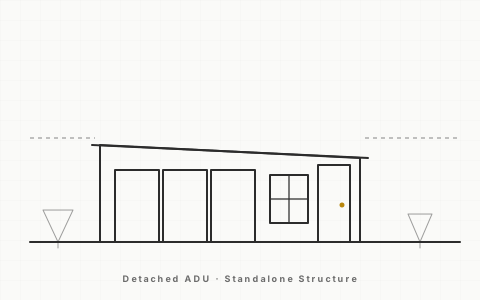
Architectural sketch of a detached ADU with bi-fold glass doors

Detached ADU

A standalone unit in the backyard. Best for rental income or guest-house use. Typically 400-1,200 sqft under California rules, with its own kitchen, bath, and entrance. Most flexible floor-plan option.

See our Hillsborough ADU →
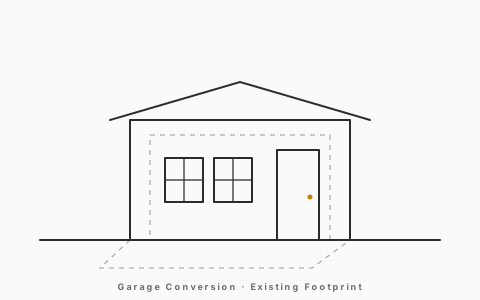
Architectural sketch of a garage conversion ADU

Garage Conversion

Converting an existing detached or attached garage into a livable unit. Usually faster and less expensive than a ground-up detached ADU, because the structure already exists. Parking implications depend on the city.
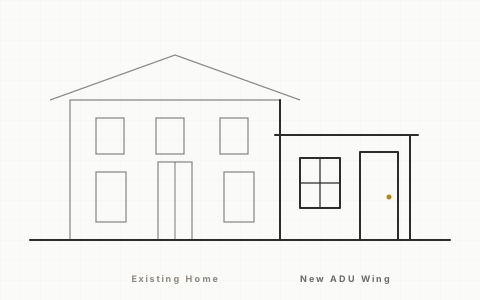
Architectural sketch of an attached ADU wing

Attached ADU

An addition to the main house with its own entrance, kitchen, and bath. Works well when the lot is small, or when an older parent wants proximity without separation. Shares systems with the main house.
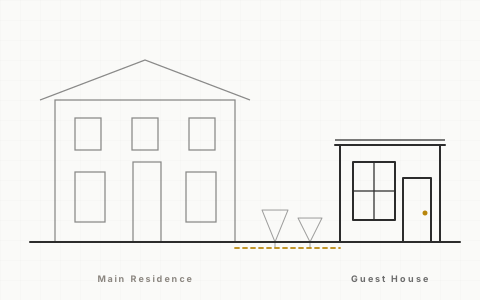
Architectural sketch of a compound-style guest house separate from the main residence

Compound-Style Guest House

In towns like Atherton and Woodside, we often build detached units that read less as an ADU and more as a second structure on a compound. Architect-led design, high-end finishes, structured as part of an integrated site plan.

The 2026 ADU Landscape

California's rules just got friendlier. The local implementation still matters.

The 2026 updates (SB 543, AB 1154, AB 462, plus SB 9 clarifications) are the most significant ADU rule changes in years. Here's what's actually different, and why working with a builder who tracks both the state law and the local implementation matters.

SB 543

Streamlined permit timelines and tightened the state-level 60-day clock cities must meet once a complete ADU application is submitted. In practice, this turns the permit window into something planners can count on, provided the submission is actually plan-review ready.

AB 1154

Expanded design flexibility on setbacks, attachment configurations, and parking requirements. More lots now pencil out for ADUs that would have been impossible under the older rules.

AB 462

Removed several barriers that cities used to add to discourage ADU builds, particularly around owner-occupancy requirements and fees. State law now preempts these in most cases.

SB 9 (Clarified)

The lot-split and duplex-conversion rules from SB 9 got clarified in 2026 to reduce friction. More properties now qualify for duplex conversions paired with ADUs, turning single-family lots into legitimate multi-unit investments.

The state writes the rules. The city enforces them. We track both, because the difference between a 60-day permit and a 6-month permit is usually in how the application reads, not in the law.

60-day clock
We submit plans complete the first time
Weekly updates
Progress reports by text or email
Skilled trades
Electrician, plumber, roofers in-house
4-6 months
Typical design-to-permit timeline

Our ADU Process

From first site walk to handover, without surprises.

1. Site walk & feasibility

We visit the property together and confirm what's buildable: setbacks, trees, utilities, access, lot coverage, and the right ADU type for your situation. If a detached unit won't pencil out, we'll tell you before you pay for drawings.

2. Design & engineering

We work with you (or with your architect) to develop plans that anticipate the city's review criteria. Typically 6 to 12 weeks, depending on scope and city.

3. Permit

Complete submission on day one. California state law caps the review at 60 days. Most of our ADU permits land inside that window because we don't submit incomplete applications.

4. Construction

Typical build runs 4 to 7 months, depending on ADU type, lot complexity, and finish level. Our on-site and off-site hybrid approach often compresses the schedule, especially on detached units. Weekly updates throughout.

5. Handover & lease-ready

Final inspections, certificate of occupancy, and full systems documentation. For investor builds, we hand over lease-ready (appliance manuals, utility transfer notes, maintenance schedule). For homeowner builds, we give you everything you need to live in it from day one.

ADU FAQ

Questions homeowners and investors ask us.

+How fast can an ADU get built in 2026?

Total timeline from first site walk to certificate of occupancy is typically 10 to 14 months. Design and permit prep: 6 to 12 weeks. State 60-day permit review clock: up to 8 weeks. Construction: 4 to 7 months. Faster is possible with a tuned spec and a simple lot; longer is normal on hillside sites or with architect-led custom design.

+Do I have to live on the property if I build an ADU?

Owner-occupancy requirements have been largely preempted by state law. In most California cities, you can build an ADU and rent both the ADU and the main house to different tenants without living on-site yourself. This is a meaningful change for investors. Rules vary slightly by city; we'll confirm what applies to your specific property.

+Can I rent the ADU short-term (Airbnb-style)?

Short-term rental rules are set by each city, not the state. Some Peninsula cities allow it with registration and a transient occupancy tax; others restrict ADUs to 30-day-plus leases. We'll confirm the specific rules for your city before you budget around short-term rental income.

+What ADU size can I build on my lot?

California state law allows detached ADUs up to 1,200 sqft regardless of local zoning in most cases. Some cities allow larger if the lot supports it. Attached ADUs are usually capped at 50 percent of the main house's floor area, up to 1,200 sqft. We'll confirm what your lot supports on the first site walk.

+Can you build multiple ADUs across a portfolio of properties?

Yes. For investor partners building across several lots, we develop a tuned spec (finish package, systems spec, floor plan family) and build to it consistently. Keeps per-unit costs predictable and keeps the construction quality consistent across properties. Happy to talk through the economics.

+How does off-site construction work on your ADU projects?

For many ADU projects, we build certain components (wall assemblies, millwork, bath modules, structural panels) off-site at a fabrication shop, then deliver and integrate them on-site. The tradeoff is a tighter schedule and often a lower total cost, because labor on-site is minimized. We'll walk you through which elements make sense to fabricate off-site on your specific project.

Thinking about an ADU?

Let's walk the property and run your numbers.

No pressure, no obligation. We'll look at your lot, talk through the options, and give you an honest read on what's buildable and what it'll cost, for homeowners and investors alike.

Let's talk