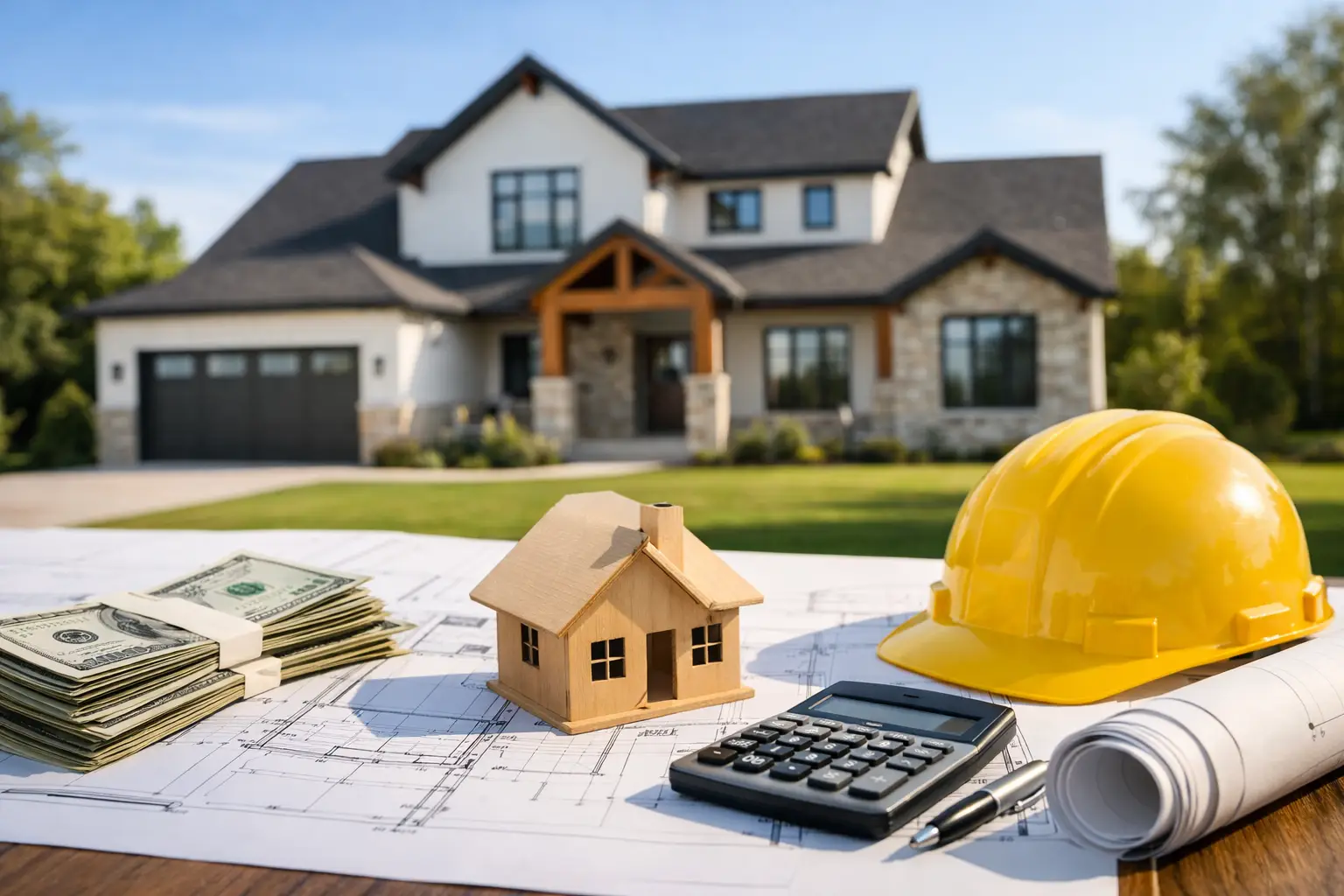
Sticker shock usually hits at the same moment: the first real budget conversation, when a homeowner realizes a custom home is not priced like a production build or a cosmetic remodel. If you're asking how much does it cost to build a new custom home, the honest answer is that the range is wide - and on the San Francisco Peninsula, the reasons behind that range matter just as much as the number itself.
For a true custom home in this market, construction costs often start around $700 to $900 per square foot for a well-executed, high-quality build, and can move well beyond $1,000 per square foot depending on design complexity, site conditions, structural demands, finish level, and jurisdiction requirements. That does not always include land, major site development, utility upgrades, extensive retaining, or the full soft-cost picture. For many Peninsula homeowners, the all-in project cost lands significantly higher once design, engineering, permits, consultants, and contingency are included.
That may sound like a broad answer, but broad answers are the only honest starting point. A custom home budget is built from dozens of decisions, and each one affects control, schedule, and long-term value.
How much does it cost to build a new custom home on the Peninsula?
In markets like Atherton, Palo Alto, Los Altos, Hillsborough, Menlo Park, Burlingame, and Woodside, labor standards are high, permit processes are detailed, and homeowner expectations are rightly demanding. You're not just paying for square footage. You're paying for structural execution, energy compliance, waterproofing, mechanical performance, finish quality, and a team that can carry the project from feasibility through final inspection without losing control of the details.
A 3,500-square-foot custom home at $800 per square foot suggests a base construction cost of $2.8 million. At $1,050 per square foot, that same home is $3.675 million before additional project costs outside the core build contract. If the lot requires grading, drainage improvements, deep foundations, substantial retaining walls, difficult access, or utility coordination, the budget climbs quickly.
This is why experienced builders avoid giving a casual number too early. An attractive estimate that ignores the site, the drawings, or the city is not a savings. It is a delayed problem.
What drives custom home cost the most?
Size matters, but not in the way many homeowners assume. Larger homes cost more overall, yet smaller homes with highly customized architecture can carry a higher per-square-foot cost because the expensive parts of the house do not scale down neatly. Kitchens, baths, steel, specialty glass, stair systems, and complex HVAC still cost what they cost.
Design complexity is one of the biggest price drivers. A clean rectangular footprint with straightforward rooflines is far more efficient to build than a house with large cantilevers, hidden gutters, expansive pocket doors, custom steel details, or intricate indoor-outdoor transitions. Modern homes often look simple when finished, but they can be among the most exacting and expensive projects to execute properly.
Site conditions can be just as significant as architecture. Flat lots with good access are generally more predictable. Sloped sites, limited staging space, protected trees, poor soil, tight setbacks, and neighborhood constraints create real cost. So do older utility connections that need replacement or upgrades.
Finish level is the category homeowners feel most directly. White oak cabinetry, premium stone slabs, custom millwork, steel windows, integrated lighting, and top-tier appliance packages can transform a home, but they can also shift a budget by hundreds of thousands of dollars. None of that is inherently excessive. It simply needs to be scoped honestly, early, and in alignment with the overall investment.
The costs beyond the build itself
One of the most common budgeting mistakes is focusing only on the construction contract. A new custom home has soft costs that should be planned from the beginning.
Architectural design, structural engineering, civil engineering, Title 24 and energy compliance, survey work, geotechnical review, permit fees, school fees, utility applications, and specialty consultants all add to the total project cost. In high-value jurisdictions, permit-related expenses alone can be substantial.
Then there is contingency. Even with strong planning, custom homes involve decisions that evolve as the project becomes more detailed. Material availability changes. Jurisdiction comments can force revisions. Existing site conditions may reveal work that was not fully visible at the start. A disciplined contingency is not pessimism. It is part of building responsibly.
For many homeowners, a practical planning framework is to separate the budget into three buckets: hard construction costs, soft costs, and contingency. That creates a more realistic view of what the project actually requires.
Why two homes of the same size can have very different budgets
A 4,000-square-foot home can be materially less expensive than another 4,000-square-foot home built a few miles away. The difference often comes down to what is hidden behind the finish materials.
Structural engineering is a good example. Large open spans, hillside conditions, expansive glass, and seismic demands can require far more steel and specialized framing than a simpler plan. Mechanical systems are another. Zoned HVAC, smart home integration, advanced ventilation, battery backup coordination, and high-performance building envelope details all improve the finished home, but they also require more coordination and labor.
The building team matters too. A project run with fragmented responsibility often appears cheaper early and becomes more expensive later through delays, scope gaps, weak trade coordination, and reactive change orders. Homeowners who want a premium result usually benefit from one accountable team that can manage scoping, scheduling, and execution without finger-pointing.
That is part of why full-service builders with stronger in-house control tend to produce more dependable outcomes. When key trades and field leadership are aligned under one standard, quality control improves and budget conversations get more honest.
How to budget without guessing
The best early budget is not a rough national average. It is a local, scope-based feasibility review tied to your lot, your goals, and your level of finish. Before final plans are completed, a builder should be able to help pressure-test whether the design is tracking toward your investment range or drifting beyond it.
That process usually starts with a few grounded questions. What is the target square footage? Is the architecture restrained or highly customized? Is the lot straightforward or technically difficult? What level of finish is expected? Are there site improvements, pool elements, detached structures, or ADU components that need to be included?
Early budget alignment is where many expensive mistakes are avoided. If a design is moving toward a cost level that does not match the owner's priorities, the smartest time to make adjustments is before permits and procurement, not after demolition or excavation begins.
Where homeowners should be careful
The lowest number in the room is not always the most competitive number. In custom residential construction, under-scoped proposals often leave out coordination, site logistics, finish assumptions, or code-driven requirements that appear later as extras. That creates stress, weakens trust, and makes decision-making harder exactly when the project should be moving forward with confidence.
Be especially careful with allowances that are too low to match your expectations. A budget may technically include tile, plumbing fixtures, appliances, and lighting while still being unrealistically thin for the level of home you intend to build. The proposal looks complete. The actual selections tell a different story.
It also helps to ask how the builder manages changes. No serious custom project is completely static. What matters is whether the scope is clearly defined, pricing is communicated promptly, and the client always understands what is changing and why.
So, what should you expect?
If you are planning a new custom home on the Peninsula, expect the real conversation to go beyond cost per square foot very quickly. That metric is useful for orientation, but it is not a substitute for project-specific budgeting. A home designed for lasting quality, tight execution, and a smooth build experience should be evaluated as a full investment, not a headline number.
For homeowners who value durability, accountability, and craftsmanship built right the first time, the better question is not only how much the house will cost. It is whether the team, scope, and process are strong enough to protect that investment from the first planning meeting through final completion. That is where the right project starts to feel less like a gamble and more like a well-run build.
On a project this personal and this significant, clarity is worth paying for early.