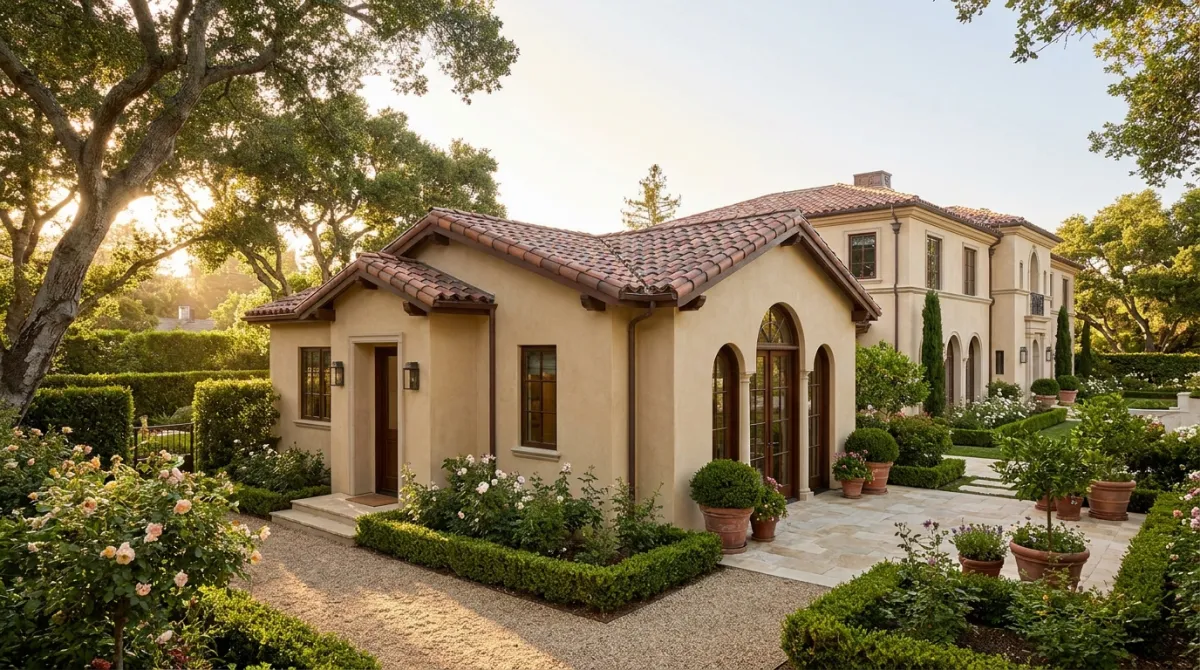
Most people think the hard part of building an accessory dwelling unit in Hillsborough is the square footage or the budget. On the estates we work on here, the hard part is making the new structure look like it has always been there. Hillsborough holds detached buildings to a high standard of architectural harmony, and a guest house that reads as an afterthought will not get through review, no matter how nice it is on its own.
We have built enough on the Peninsula to know that this is a design problem first and a construction problem second. Here is how we think about it.
Why "matching" is the whole game in Hillsborough
The town wants detached structures to blend with the primary residence so the neighborhood character and the value of the estate are protected. In practice that means your ADU needs to carry the same architectural language as the main house. If the house is Mediterranean, the guest house should speak Mediterranean: the same custom-tinted stucco, the same clay or slate roof profile, the same window proportions and trim details. Tudor and Georgian estates have their own vocabulary, and the review looks for it.
This is not about copying one or two features. It is about the new building feeling like it came from the same hand as the old one. That is a craft question, which is exactly why an in-house trade team matters. The roofers, the finish carpenters, and the people mixing and applying the stucco all need to hit the same notes the original builder did.
The detached ADU envelope you are working inside
A detached ADU in Hillsborough can generally reach up to 1,200 square feet for a two-bedroom unit, and it is held to a single-story height limit of roughly 16 feet. That height ceiling shapes everything. You are designing a building that has to feel gracious and full of light without a second story to give it volume.
We get there with the ceiling, not the footprint: a raised plate line, scissor or vaulted framing where the roof allows, and glass placed to pull in light and garden views. A well-designed single-story guest house can feel far larger than its number on paper. Always confirm the current size and height limits with the town before you design, because these rules move.
If you are managing it yourself, avoid the prefab trap
Homeowners acting as their own builder often start with an off-the-shelf prefab ADU, assuming a coat of paint in the right color will satisfy the planners. In Hillsborough that usually leads to a plan-check rejection and a round of expensive redesign. A standardized box does not carry the cladding, the trim, or the roof material the review wants to see next to a custom estate.
If you go the owner-builder route, start with a careful study of the existing house: document the stucco texture and color, the roof material and pitch, the eave and window details, then source materials that actually match. That analysis is the first step, not a finishing touch. It is the difference between one submittal and three.
Plan the infrastructure before you fall in love with the design
An ADU is not just a small house, it is a load on systems that were sized for the main residence. Before the design gets too far, we look at the electrical service, the water pressure and fire flow at the street, and how the new unit ties into existing utilities. Catching a needed service upgrade early keeps it from becoming a surprise halfway through the build. You can read more about how we sequence this kind of work on our process page, and see a real example on our Hillsborough ADU project.
Where this lands
A great Hillsborough ADU is a small building that carries a large house's DNA. Get the architecture right and the review goes smoothly. Get it wrong and you are paying for the lesson in redesign fees. If you are weighing a detached ADU on a Hillsborough estate, we are glad to walk the property and talk through what the design review will and will not allow before you spend a dollar on drawings.