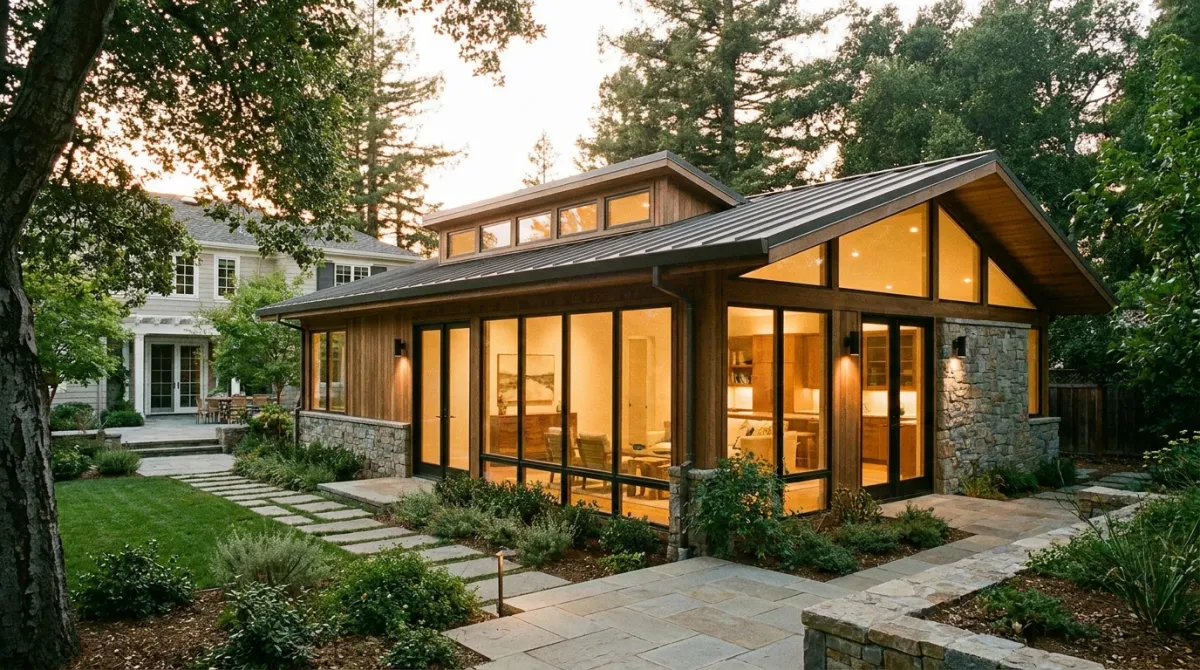
In most of Hillsborough, a detached ADU is a single-story building. The town holds these structures to a height limit in the range of sixteen feet, which means a second story is off the table before you draw the first line. That sounds like a constraint that flattens the design. In practice, it just moves the work. The question stops being how tall and becomes how to make a low building feel open, bright, and larger than its footprint.
This is a problem both kinds of owners run into. If you are hiring out the whole project, you want to know why a good ADU costs real design attention and not just a stock plan. If you are building it yourself, you want to know exactly where the height limit will bite you, because it bites hardest at the worst possible moment.
Why the 16-foot ceiling is the whole design problem
A two-story house hides its volume vertically. You stack rooms and the building feels generous because you move through it up and down. A single-story ADU has none of that. Every cubic foot of interior openness has to come out of one floor plate and one roof. So the height limit is not a footnote to the design. It is the design. Get a few feet of usable volume in the right places and a 600-square-foot unit reads like a small, light-filled home. Miss it and the same square footage feels like a converted garage.
One more thing worth saying plainly: codes change, and Hillsborough applies its own zoning on top of state ADU law. Treat any number you read, including the sixteen-foot figure, as a starting point to verify with the town's planning counter before you commit a design. We always confirm the current limit in writing for the specific parcel.
Where the volume actually comes from
Inside a fixed height envelope, a few moves do most of the work. They are not exotic, but they have to be planned together, not bolted on later.
- Raised plate lines. Pushing the wall plate up before the roof begins buys ceiling height across the whole room. Even a modest raise changes how a space feels the moment you walk in.
- Vaulted or scissor framing. Where the roof form allows, opening the ceiling to follow the rafters, or using a scissor truss, turns dead attic space into living volume. This is where most of the drama comes from.
- Sub-grade floor steps. Stepping the finished floor down a foot or two in a living area gains ceiling height without adding building height. It is one of the few ways to win volume from below instead of above.
- Glass placed for light, not symmetry. Clerestory windows high on a vaulted wall pull daylight deep into the plan. Larger openings sited toward a garden or a mature tree borrow the outdoors and make a small room feel like it has somewhere to look.
The reason these belong on one drawing set is that they trade against each other. A sub-grade step gives you ceiling room, but it also affects drainage and the path to the door. A vault wants a steeper roof, and a steeper roof eats into your height budget. Designing them in isolation is how you end up with a plan that works on paper and fails at the limit.
The trap that catches owner-builders
Here is the specific way a self-built ADU goes wrong. Height is measured to a defined point, and your finished-floor elevation plus your roof pitch plus your ridge detail all stack up to it. Small errors compound. A finished floor poured an inch or two high, a roof pitch bumped up to get a nicer vault, a ridge cap nobody counted, and suddenly the building is over the legal height. None of those mistakes feel large on their own.
The cruel part is the timing. A height violation is usually caught at framing inspection, after the structure is standing. By then the fix is not a pencil change. It can mean lowering a roof, re-cutting rafters, or in a bad case re-pouring a slab. That is among the most expensive ways to learn a number you could have verified up front. An experienced builder runs the height stack-up as a budget, tracks every component against it, and confirms the datum with the town before concrete is ordered.
Light is the other half of feeling big
Volume without light still reads as a low room. The two have to be solved together. A vaulted ceiling with a single small window feels like an attic. The same vault with a run of clerestory glass feels like a pavilion. On a Hillsborough lot, that often means orienting the main openings toward the garden, the canopy of an existing oak, or whatever the property already gives you, and using higher glass to bring in even, indirect light that does not bake the room. This is the same instinct that makes a good kitchen or a well-planned remodel feel calm rather than cramped, applied to a building with no second floor to lean on.
Planning the envelope before you fall in love with a layout
The order of operations matters. Settle the height strategy first: where the vaults go, where the floor steps, how the roof reads from the street, and how all of it sums under the limit. Then lay out rooms inside that envelope. Doing it the other way around, drawing a floor plan you love and then discovering the ceiling cannot rise to meet it, is how good ideas die late. This is the part of our process we spend the most care on for a detached unit, and you can see how it plays out in built work on our portfolio.
If you are weighing a detached ADU in Hillsborough and want to know what volume is realistically available under the height limit for your specific lot, we are glad to walk the property and talk it through before any drawings start.