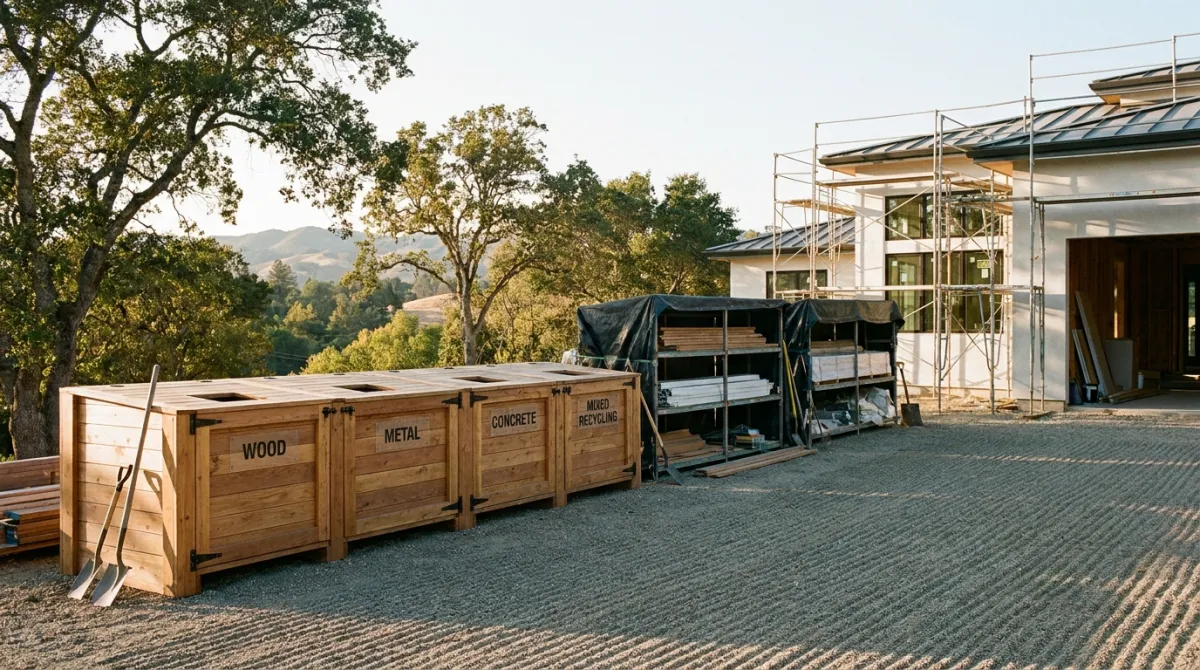
Most owners think about construction waste as a dumpster in the driveway. In Los Altos it is a permit condition. Demolition and larger building permits generally require that at least sixty-five percent of the non-hazardous construction and demolition debris be recycled or salvaged, and that you document it through the city's green-building tracking. The rule is not hard to meet. Proving you met it is where unprepared projects lose time and money.
This is worth knowing on either side of the job. If you are hiring a builder, it is a reason to ask how they handle waste tracking, because a sloppy answer means schedule risk. If you are running it yourself, it is an administrative burden that is easy to underestimate and expensive to fumble.
Thresholds and the tracking process change. Treat the figures here as the shape of the rule, and confirm the current requirements with the city for your permit. We set up the tracking before demolition, not after.
What the rule actually requires
The standard is a diversion rate: keep at least sixty-five percent of eligible debris out of the landfill by recycling or salvaging it, and document the weights through the city's portal. That means the wood, metal, concrete, drywall, and cardboard a project generates have to be sorted to facilities that recycle them, and you need verified weight tickets to prove where it all went. The number is the easy part. The chain of paperwork that backs it up is the work.
Done well, this barely touches the schedule. Done as an afterthought, it becomes a paperwork emergency at the worst time, when you are trying to close out and get final approval.
Where the deposit goes to die
Los Altos often ties this requirement to a permit deposit, money you get back when you document the diversion. The trap for owner-builders is simple: mixed debris hauled to a single landfill cannot be counted, and weight tickets that were never collected cannot be produced. Miss the documentation and you can forfeit the deposit, on top of any delay to the permit closeout.
The failure is rarely the building. It is the recordkeeping. By the time someone realizes the tickets were not saved, the material is gone and the proof is unrecoverable.
How to make it a non-event
The fix is to treat waste like any other tracked part of the job. Set up on-site separation from day one, so wood, metal, concrete, and the rest go to the right facilities. Use haulers that provide verified weight tickets, and collect those tickets as you go rather than reconstructing them at the end. Log the weights into the city's portal on a running basis. Handled this way, the sixty-five percent target is met almost automatically and the documentation is already done when closeout arrives.
That kind of quiet administrative discipline is part of our process, the same attention to the parts of a job that do not show but absolutely count. You can see the finished work that comes out of it on our portfolio.
If you are planning a project in Los Altos and want the waste-diversion requirement handled cleanly so your deposit and your schedule stay intact, we are glad to walk it through with you before the first load leaves the site.