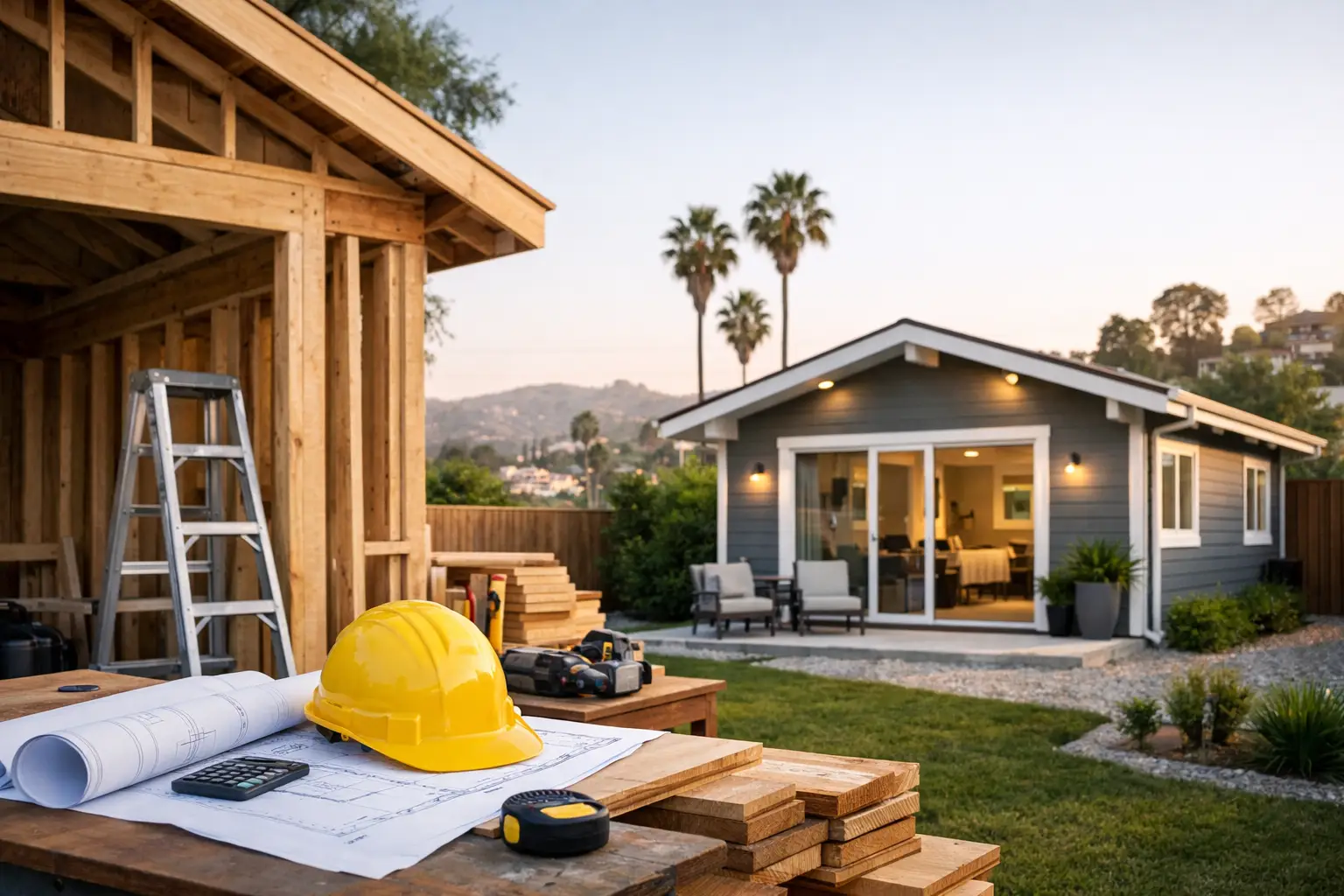
Sticker shock usually happens when homeowners compare a polished, permit-ready ADU to a rough online price per square foot. The real adu construction cost california homeowners face is shaped by far more than size alone. On the Peninsula, the difference between a straightforward backyard cottage and a fully integrated, high-finish ADU can be substantial because site conditions, utility upgrades, permitting requirements, and execution quality all move the budget.
For many homeowners in places like Palo Alto, Menlo Park, Los Altos, Burlingame, and Hillsborough, an ADU is not a speculative build. It is space for parents, adult children, guests, a caregiver, or long-term rental income tied to a valuable property. That changes the decision. You are not just buying square footage. You are deciding how durable, private, efficient, and well-resolved that structure will be for years to come.
What drives ADU construction cost in California
The first cost driver is the type of ADU you are building. A detached ADU usually costs more than a garage conversion because it requires its own foundation work, framing, roofing, exterior envelope, and more extensive utility planning. An attached ADU can land somewhere in between, depending on how much of the existing structure needs to be opened, reinforced, or reworked.
The second driver is site complexity. Flat, accessible lots with clear utility paths are less expensive to build on than steep sites, narrow side yards, or properties with drainage issues. On many Peninsula lots, getting materials and crews to the build area is not simple. If access is tight, labor hours increase and certain equipment or staging strategies may be required.
Utility infrastructure also has a major effect on budget. Sewer lateral condition, electrical capacity, gas routing, water service, and fire safety requirements can all add cost before finishes even enter the conversation. A homeowner may expect the money to go into cabinets and tile, then learn that trenching, panel upgrades, or utility separation are taking a significant share of the budget.
Then there is the quality level. A basic ADU intended as a simple rental unit costs less than one designed to match a primary residence in a premium neighborhood. High-performance windows, custom cabinetry, better insulation assemblies, elevated lighting design, and cleaner built-in storage all matter. So does the standard of construction behind the walls. The least expensive number is rarely the number that protects long-term value.
Typical adu construction cost california ranges
There is no single statewide number that tells the whole story, especially not for San Mateo and Santa Clara Counties. Broadly speaking, garage conversions can start lower than ground-up detached units, but they often carry hidden complications. Existing slabs may not meet requirements, walls may need significant structural work, and old utilities may need to be replaced rather than reused.
For a detached ADU on the Peninsula, homeowners should generally expect pricing that reflects premium labor markets, stricter local review, and higher finish expectations. Small units are not automatically cheap. Kitchens, bathrooms, HVAC, appliances, utility connections, and permitting are still there whether the building is 500 square feet or 900. That is why smaller ADUs often have a higher cost per square foot than larger ones.
A realistic budgeting conversation usually starts with total project cost, not just a square-foot metric. That total should account for design, engineering, permitting, demolition if needed, site work, utility work, construction, and a contingency for conditions that become visible only after the project begins. Homeowners who budget only for the visible structure often end up revising expectations late, which is exactly when decisions become more expensive.
Why price per square foot can mislead
Price per square foot is useful for rough orientation, but it is a weak planning tool on its own. ADUs compress expensive rooms into a smaller footprint. A compact one-bedroom unit still needs a kitchen, bath, water heater, ventilation, electrical distribution, and code-compliant life safety components. Those systems do not shrink in cost as quickly as square footage does.
There is also a design-efficiency question. A well-planned ADU can feel generous without becoming oversized, but efficient design often requires more coordination upfront. Window placement, storage, ceiling heights, privacy from the main house, and indoor-outdoor relationships all affect livability. Good design may cost more at the front end while reducing costly revisions and improving value over time.
That is one reason disciplined builders focus on honest scope instead of attractive headline pricing. If a number looks unusually low, it often excludes real project components or assumes allowances that do not match the quality level the homeowner actually wants.
The biggest line items in an ADU budget
Construction cost usually breaks into a few major categories. Structure and envelope form a large share of the budget, especially on detached units. That includes foundation, framing, roofing, windows, siding, insulation, drywall, and exterior finishes. On a premium property, exterior detailing matters because the ADU needs to feel consistent with the home rather than like an afterthought.
Mechanical, electrical, and plumbing are another major cost center. This is where many budgets move quickly. Mini-split systems, tankless water heaters, recessed lighting, EV-ready electrical planning, upgraded panels, and clean plumbing layouts all improve performance, but they need to be properly coordinated. When these trades are well managed, the work tends to move faster and with fewer corrections.
Interior finishes can range widely. Stock materials and straightforward layouts keep costs tighter. Custom millwork, stone selections, premium plumbing fixtures, integrated appliances, and more detailed trim packages raise the budget. Neither approach is inherently right or wrong. It depends on whether the ADU is being positioned as a simple utility space or as an extension of the standard set by the main residence.
Site work and soft costs are often underestimated. Excavation, drainage improvements, retaining conditions, surveys, architectural plans, structural engineering, energy compliance documentation, permit fees, and school or utility-related fees can materially affect the total. These are not optional extras. They are part of what it takes to get a project approved and built right the first time.
Peninsula factors that push costs higher
Building in the Bay Area is not the same as building in lower-cost parts of California. Labor rates are higher, municipal review can be more demanding, and homeowner expectations around fit, finish, and longevity are typically elevated. In neighborhoods where the primary residence is already a significant asset, the ADU has to support that value, not undercut it.
There is also the matter of logistics. Tight setbacks, mature landscaping, occupied homes, neighbor sensitivity, and limited staging areas all require more careful planning. That planning has value. The smoother a job runs, the fewer schedule disruptions and change-order surprises a homeowner faces.
This is where builder structure matters. A contractor relying entirely on outside trades may be more vulnerable to scheduling gaps, communication breaks, and inconsistent workmanship. A more accountable model, with tighter control of scope and key in-house trades, often protects the budget better even if the initial estimate is not the lowest one on the table.
How to budget smart without cutting the wrong corners
The best first step is to define the purpose of the ADU clearly. A rental unit, a guest house, and a long-term multigenerational residence do not need the same level of finish or the same design priorities. If the use case is clear early, the budget can be aligned to the right decisions instead of being stretched across competing goals.
It also helps to separate must-haves from easy upgrades. Ceiling height, insulation quality, windows, waterproofing, and utility infrastructure are hard to change later. Decorative tile patterns, certain fixture upgrades, or some built-ins may be easier to phase or simplify if needed. Protect the bones first.
Homeowners should also carry contingency, especially for conversions or older properties. Existing conditions have a way of showing up once walls are opened or utility work begins. A realistic contingency is not pessimism. It is good project discipline.
Most of all, ask for a budget that is grounded in real scope. That means clear assumptions, transparent allowances, and direct conversation about what is included and what is not. Westward Construction approaches ADU planning this way because a premium project only feels premium when the process is controlled, accountable, and honest from the start.
What a better ADU investment looks like
A well-built ADU does more than add legal square footage. It creates flexibility on a property that may need to serve a family in different ways over time. It can support aging parents, returning college graduates, live-in help, or income without forcing a move. On the Peninsula, that kind of flexibility has real value.
The right question is not whether you can find the cheapest adu construction cost california number online. The better question is what level of planning, construction quality, and builder accountability will give you a finished space that feels right on your property and continues to perform years from now. That is usually where the smartest money gets spent.