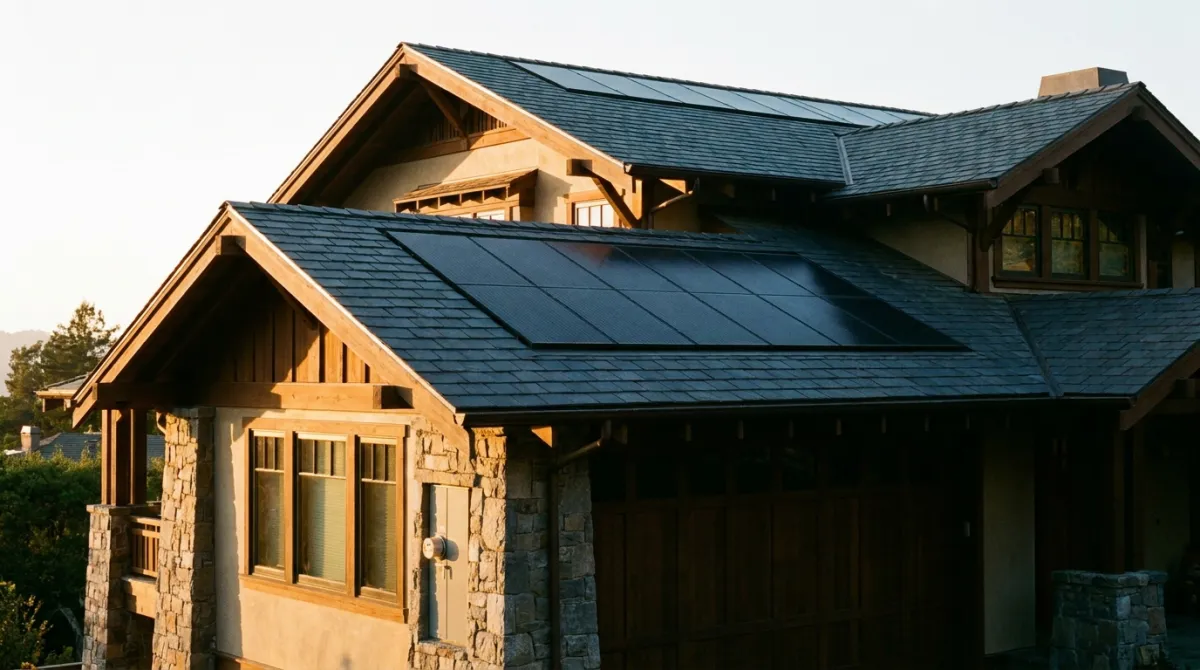
When people picture building an ADU in Hillsborough, they picture the floor plan. The parts that actually stall a project sit underneath the design: whether the unit owes solar, whether the street can deliver enough water to fight a fire, and whether the existing electrical service can carry one more building. None of these show up in a rendering. All of them show up at permit review.
This matters to both kinds of owners. If you are hiring a builder, this is exactly what you are paying them to see coming. If you are building it yourself, these are the three places a Hillsborough ADU quietly runs over budget, and each one is far easier to solve on paper than in the field.
A word before the specifics. Energy code, fire standards, and utility rules all change, and Hillsborough layers its own requirements on top of state law. Treat every rule below as a starting point to confirm with the town and the utilities for your exact parcel. We verify each one in writing before design begins.
Solar, and the exemption most small units qualify for
California energy code generally expects solar on a new detached ADU. That sounds like a fixed cost you cannot design around. In practice, smaller detached units, often those under a set size in our climate zone, can qualify for an exemption from the solar requirement. The threshold is specific and it moves, so the size of your unit is not only a design choice. It can decide whether you owe a rooftop array at all. Planned early, a few square feet on either side of that line can change the system cost of the entire project.
Fire flow, the requirement that is not about sprinklers
There is a common misread here. Fire sprinklers inside the ADU are generally required only if the main house already has them. Many older Hillsborough homes do not, so owners assume fire protection is a non-issue. It is not. Separate from sprinklers, the new structure has to be served by adequate fire flow: enough water, at enough pressure, available at the street to fight a fire. On large lots with long driveways and older mains, that standard is not automatic. If the flow or the pressure falls short, the fix can reach the water main or the service line, which is a civil cost, not a framing one. On an estate parcel that surprise can dwarf the cost of the building itself.
The service upgrade nobody puts in the budget
This is the one that catches owner-builders. An ADU is not just rooms, it is load. Add the new unit's demand to the existing house, then add solar and modern electric appliances, and the combined draw can exceed what your current electrical service was ever sized to carry. When that happens you need a service upgrade, and a service upgrade usually means coordinating with PG&E on a timeline you do not control. The trap is assuming you can simply tie the new building into the panel you already have. Sometimes you can. Often, at the load a full ADU adds, you cannot, and learning that after the walls are closed is the expensive way to learn it.
Why these get solved first, not last
The thread connecting solar, fire flow, and electrical service is that all three are systems decisions, and all three are cheapest to settle before the design is locked. The size that earns the solar exemption, the water service that satisfies fire flow, the panel and service that carry the load: each one sets a hard boundary the floor plan has to live inside. Settle them first and the rest of the project is design. Discover them late and they become change orders. This is the part of our process we deliberately front-load for a detached unit, and it is why the unglamorous early questions tend to save the most money. You can see how that care shows up in finished work on our portfolio.
If you are weighing an ADU in Hillsborough and want to know which of these apply to your specific lot before you spend on drawings, we are glad to walk the property and map the systems with you first.