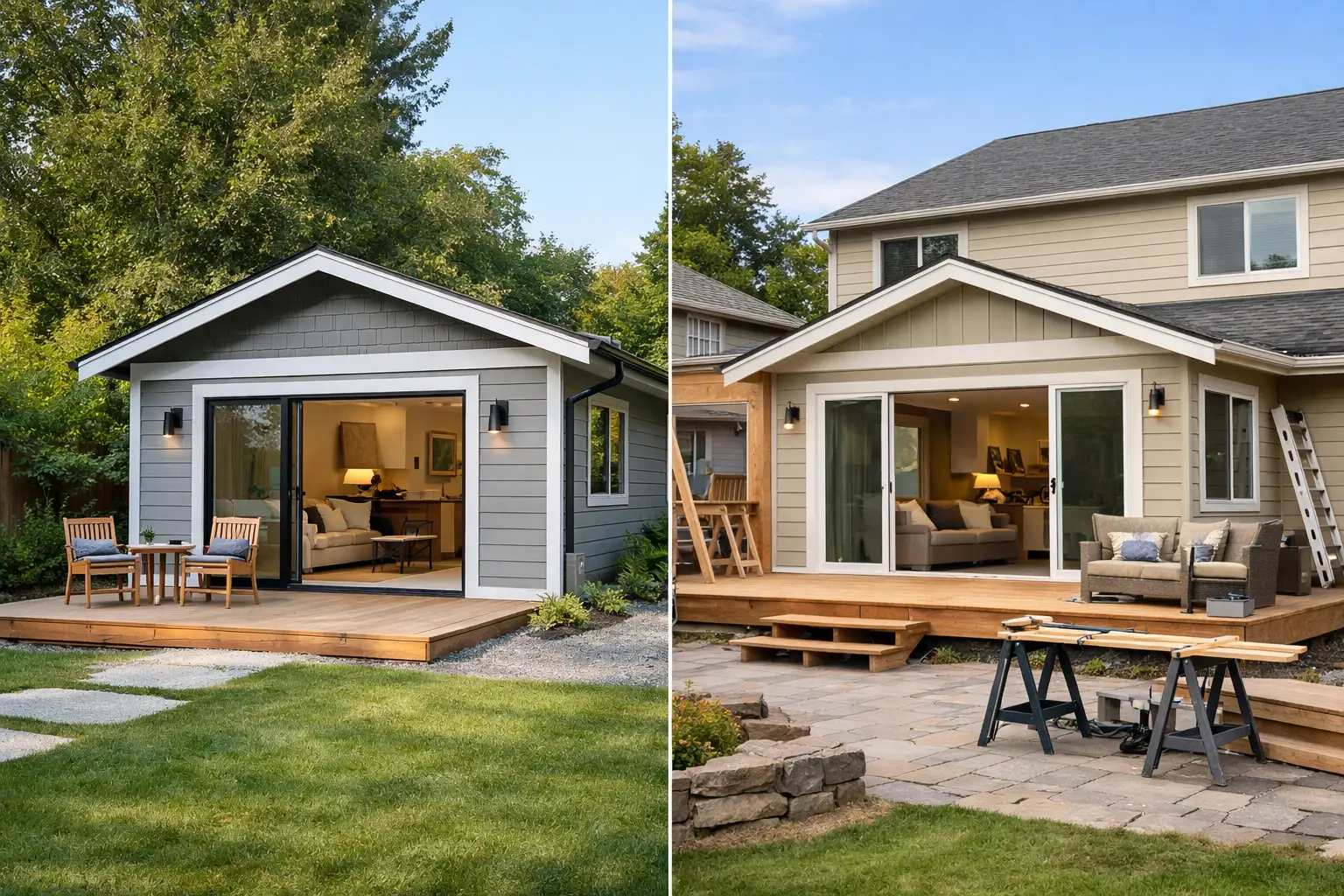
If your house feels tight but moving makes little sense, the real question is usually not whether to build. It is adu vs home addition - and which option actually fits the way you live, your lot, and your long-term plans. On the Peninsula, that choice can affect everything from permit strategy and construction disruption to resale value and family privacy.
For some homeowners, the answer is obvious within ten minutes. If you need a private place for parents, an au pair, adult children, or rental income, an ADU tends to rise to the top quickly. If you love your current floor plan and simply need more integrated square footage, an addition often makes more sense. But many projects live in the gray area, and that is where good planning matters.
ADU vs home addition: the core difference
An ADU, or accessory dwelling unit, is a separate living space with the features needed for independent occupancy. In most cases that means a kitchen, bathroom, sleeping area, and its own entrance. It may be detached, attached, or created within existing space, depending on the property and local rules.
A home addition expands the primary residence itself. You might add a family room, primary suite, second story, expanded kitchen, or a new wing for bedrooms. The new space functions as part of the main home rather than as an independent dwelling.
That distinction sounds simple, but it changes the entire project. The minute a space becomes a separate dwelling, privacy, utility planning, setbacks, parking considerations, code requirements, and permit pathways can all shift.
When an ADU is the stronger choice
An ADU is often the right move when independence matters as much as square footage. If your goal is to create a comfortable place for extended family without forcing everyone into the same daily rhythm, a detached or well-planned attached ADU offers real separation. That separation is not just emotional. It affects noise, kitchen use, guests, schedules, and the ability for different generations to feel at home under one property umbrella.
On the Peninsula, ADUs also appeal to homeowners thinking beyond immediate need. A guest house today may become a caregiver suite later. A private residence for aging parents may eventually serve an adult child returning from college or generate rental income. That kind of flexibility is hard to ignore when land is limited and home values are high.
There is also a property-planning advantage. In some cases, building an ADU can preserve the existing house with less invasive surgery than a major addition. Instead of tearing into a kitchen, relocating bedrooms, or disrupting core circulation, the project happens more independently on the lot.
That said, ADUs are not automatically easier. They still require thoughtful site planning, utility coordination, and a realistic understanding of local jurisdiction review. A detached structure with a kitchen and bath is a small home, not a simple outbuilding.
When a home addition makes more sense
A home addition is usually the better answer when you want the new space to feel inseparable from the main house. If your family needs a larger kitchen, a better primary suite, a playroom near the main living area, or upstairs bedrooms connected by the same hallway, an addition supports that lifestyle in a way an ADU cannot.
Additions also tend to make more sense when the property has limited yard area or awkward site constraints. If there is no clean place to position a detached unit without compromising outdoor living, privacy, or access, expanding the existing structure may be the smarter use of the lot.
There is also the matter of architecture. In many high-value neighborhoods, homeowners care deeply about a house feeling coherent from the street and from inside. A well-designed addition can make an older home live better while preserving proportion, light, and resale appeal. The best ones do not look appended. They look like they were always meant to be there.
Cost is not just about square footage
Many homeowners begin with a simple assumption: an addition must cost less because it is part of the house, or an ADU must cost more because it needs a kitchen and bath. Sometimes either assumption proves wrong.
In an adu vs home addition comparison, cost depends heavily on what you are building and where. Kitchens and bathrooms drive cost because they require plumbing, electrical, fixtures, ventilation, and finish coordination. A detached ADU typically includes all of that in a compact footprint, along with its own foundation, exterior envelope, and utility connections.
An addition may avoid a second kitchen, but it can trigger structural work, complex tie-ins to the existing home, roof reframing, temporary protection, and more disruption to occupied spaces. A second-story addition, for example, can be substantially more complex than it sounds on paper.
The honest way to compare cost is to look at total scope, not just price per square foot. Site work, engineering, utility upgrades, energy code compliance, and finish expectations all matter. Premium homeowners should also account for the cost of getting it wrong. Cheap decisions during planning tend to become expensive corrections during construction.
Privacy, livability, and family dynamics
This is where the decision gets personal.
If the goal is multigenerational living, an ADU often wins on dignity alone. Parents or adult children have their own front door, kitchen, and daily routine. Everyone stays close, but not crowded. For many families, that arrangement preserves relationships just as much as it creates housing.
A home addition can still support multigenerational use, especially with a first-floor suite, private sitting room, or separate entrance. But unless it is designed very carefully, the space may feel like an extension of the same household rather than an independent residence. That can be exactly right for some families and exhausting for others.
The same applies to guests, work, and lifestyle. If you need a quiet office, fitness room, or extra bedrooms tied to the main house, an addition supports daily convenience. If you want true separation for visitors, staff, or long-term occupants, an ADU usually delivers it better.
Permits and planning on the Peninsula
Local rules matter, but so does how the project team interprets and manages them. Homeowners in cities like Palo Alto, Menlo Park, Los Altos, Burlingame, and surrounding communities already know the Peninsula is not a place for casual assumptions about permitting.
ADUs can benefit from state laws that have made them more feasible in California, but that does not mean every lot is equally straightforward. Access, utility routing, fire safety requirements, lot coverage, and neighborhood-specific constraints still shape what is practical.
Additions have their own review challenges, especially if they affect setbacks, height, floor area ratio, structural conditions, or historic considerations. In many cases, the better project is the one that threads the needle cleanly through design review and building approval, not the one that looked best in a rough sketch.
This is where a disciplined builder and design team protect the homeowner. Early feasibility work, honest scope definition, and detailed coordination can save months of revision and avoid budget drift later.
Resale value and long-term flexibility
Resale is rarely one-dimensional in premium neighborhoods.
An ADU can increase a property's appeal by offering flexibility that many buyers want but cannot easily create themselves. Multigenerational housing, guest accommodations, a private office, or rental potential all carry value. On the right property, an ADU can make a home stand out.
An addition may deliver stronger value when it improves the primary home's everyday function in a more universal way. A larger kitchen, better bedroom count, improved indoor-outdoor flow, or a true primary suite can broaden buyer appeal and improve how the house competes in its category.
The best question is not which option adds more value in theory. It is which investment makes this specific property more useful, more beautiful, and more defensible in your market segment.
How to decide between an ADU and an addition
Start with the life you want the property to support over the next ten to fifteen years. If you need independent living, future flexibility, or a separate structure with real privacy, focus first on an ADU feasibility study. If you want the house itself to function better as one home, start with an addition concept.
Then look at the lot honestly. Consider access, yard use, setbacks, utility locations, existing house layout, and where construction will create the least compromise. A beautiful idea that forces a bad site plan usually does not improve with time.
Finally, compare delivery risk, not just design intent. The right project is the one you can permit clearly, budget accurately, and build right the first time with one accountable team. That is especially true in high-value homes, where execution quality matters as much as the plan itself.
At Westward Construction, we have seen both project types succeed when they begin with disciplined planning and a clear reason for being. The strongest outcome is rarely the trend-driven choice. It is the one that fits your property, protects your investment, and makes daily life better long after construction is over.
If you are weighing adu vs home addition, slow the decision down just enough to ask the right questions early. The extra space should not only solve a problem. It should feel like it belonged there all along.