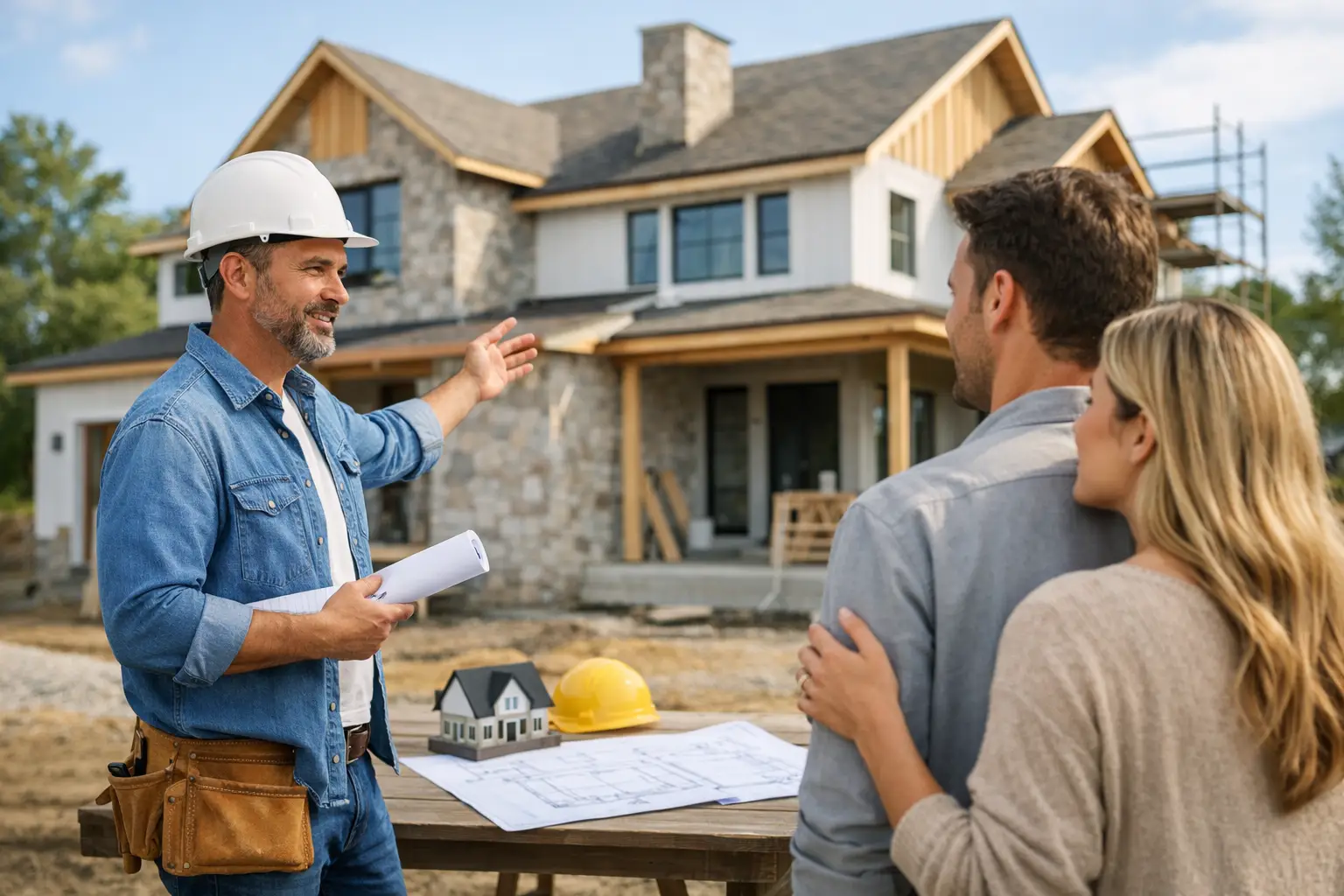
A custom home rarely gets judged by the drawings alone. What homeowners remember is how the process felt when decisions tightened, city comments came back, allowances started moving, and a hundred small details needed an owner. That is where custom home builders prove their value - or expose their weaknesses.
On the Peninsula, that difference matters more than most clients expect at the start. Building in places like Palo Alto, Menlo Park, Los Altos, Hillsborough, Atherton, and Woodside means dealing with exacting municipal review, high-performance expectations, tight sites, and a level of finish where mistakes are expensive. If you are investing in a home meant to serve your family for decades, builder selection is not a branding exercise. It is a risk-management decision tied directly to quality, schedule, and long-term value.
What custom home builders actually do
The phrase gets used loosely, and that creates confusion. Some firms are excellent at sales and outsource nearly everything once a contract is signed. Others are strong production managers but rely heavily on outside consultants to solve design and feasibility issues. A true custom home builder should be able to take responsibility for far more than framing and finishes.
At a minimum, the builder should help bring order to feasibility, budgeting, constructability, permitting, scheduling, site supervision, trade coordination, quality control, and final delivery. On more complex homes, that role expands even further. The builder often becomes the central point connecting homeowner, architect, engineer, interior designer, city reviewers, and specialty trades.
That coordination matters because custom work is rarely linear. A site condition changes the structural approach. A finish choice affects lead times. A utility requirement shifts trenching or equipment placement. If no one is truly managing the chain reaction, the homeowner pays for it in delays, change orders, and frustration.
Why one accountable team matters
Luxury homeowners often assume more vendors means more expertise. Sometimes it does. Just as often, it creates gaps in accountability.
When key scopes are scattered across too many disconnected parties, it becomes harder to control quality and harder to get a straight answer. Electrical says framing was off. Plumbing says design details were incomplete. Roofing says another trade delayed their work. The homeowner ends up standing in the middle of competing explanations with no single party owning the result.
This is where the structure of the builder matters. Custom home builders with stronger in-house capabilities usually have better control over execution because they are not rebuilding the team every time the project shifts. They can maintain tighter scheduling, enforce clearer standards, and resolve field issues faster. That does not eliminate subcontractors - no sophisticated home is built without them - but it changes the level of oversight.
For clients, the practical benefit is simple. One contract you can hold accountable is worth more than a polished proposal from a team that disappears into layers of handoff.
How to evaluate custom home builders beyond the portfolio
Beautiful photography is easy to trust and hard to verify. The better question is how the builder works when the camera is not there.
Start with scope clarity. A serious builder should be able to explain what is included, what is still an allowance, what depends on consultant input, and where the risks are. If the early numbers feel artificially clean, they probably are. Honest scope is not always the lowest number in the room, but it gives you a far better chance of protecting the budget later.
Then look at preconstruction discipline. Good custom home builders do not rush clients into the field before key decisions are ready. They spend time on pricing, plan review, engineering coordination, permit strategy, and material lead times because that work reduces avoidable change during construction. Homeowners sometimes see this phase as slow. In reality, it is often what keeps the build from becoming chaotic.
Communication is another filter. Ask how often updates are given, who sends them, how changes are documented, and who on the team has authority to answer questions. A polished salesperson is not the same thing as a reliable operating team. You want to know what the communication rhythm looks like once excavation starts and the real work begins.
Finally, ask who is actually performing the work. The answer tells you a lot about quality control. Builders with long-term in-house trades and trusted field leadership usually produce more consistent results than firms built around whoever is available that month.
The trade-offs homeowners should understand
There is no perfect project delivery model. There are only trade-offs, and the right choice depends on your priorities.
A builder with a low initial price may be appealing if you are still testing the boundaries of the budget. But lower entry pricing can come from thinner scoping, lighter supervision, or assumptions that push real costs later into the project. That does not mean every low bid is flawed. It does mean you should inspect it carefully.
A highly design-driven team may produce exceptional visual results, but if construction management is weak, those results can come with schedule drift and cost volatility. On the other hand, a builder focused only on production efficiency may not protect the design intent that made the home worth building in the first place.
The strongest custom home builders tend to balance both sides. They respect design, but they also know how to build it, price it, and sequence it. They can tell you when something is possible, when it is risky, and when there is a smarter way to get the same outcome without compromising the house.
Why Peninsula experience changes the outcome
Custom homes in San Mateo and Santa Clara Counties come with a level of local complexity that is easy to underestimate from outside the market. Site access, tree protections, wildfire-zone considerations, utility coordination, stormwater requirements, and municipal review standards all affect real cost and schedule.
A builder who knows the Peninsula understands that approvals are not just paperwork. They affect how early the team can make decisions, when procurement should start, and how to avoid costly resequencing. They also understand neighborhood expectations. In premium residential areas, jobsite discipline matters. So do noise management, staging, cleanliness, and professionalism with neighbors.
That local knowledge becomes even more valuable on remodel-to-new-home transitions, hillside lots, and projects where an older property is being replaced with a larger, more technically demanding residence. Experience helps, but relevant experience helps more.
Signs you have the right builder
The right fit usually feels less theatrical than homeowners expect. There is less selling and more specificity.
The builder asks disciplined questions about how you live, how long you plan to stay, what level of finish actually matters to you, and where flexibility exists if costs rise. They are willing to challenge assumptions before those assumptions become expensive field conditions. They talk plainly about lead times, inspections, allowances, and sequencing. Most important, they do not treat your home as a collection of isolated tasks. They treat it as a system that has to perform well long after completion.
That includes the less glamorous parts of craftsmanship. Waterproofing details. Mechanical coordination. Framing accuracy behind millwork. Roofing transitions. Electrical planning that supports how the house will be used, not just how it appears in a plan set. Premium homes succeed because the visible beauty is supported by hidden discipline.
This is also where a firm like Westward Construction stands apart when the fit is right. A hands-on approach, stronger in-house trade control, and disciplined communication do not just make the process feel better. They help protect the quality of the finished home in ways clients may not fully see until years later.
The real question to ask custom home builders
Most interviews with builders start with the wrong question. Homeowners ask, "Can you build this?" On a basic level, many builders can.
The better question is, "How do you protect this project when conditions change?" Because they will. Plans evolve. Lead times move. Site realities show up. Jurisdiction comments alter the path. The strength of the builder is not measured by whether change exists. It is measured by how clearly, quickly, and responsibly that change is managed.
A well-built custom home should feel calm even when the project itself is complex. Not because the work is simple, but because the team in charge knows how to carry the complexity for you. That is what clients are really buying when they hire a premium builder.
If you are planning a custom home, give as much attention to the operating model as you do to the finishes. Stone, steel, glass, and cabinetry matter. So does the team behind them. The right builder does more than deliver a house that photographs well. They deliver one that was built right the first time, and built to stay that way.